 LemonArcade











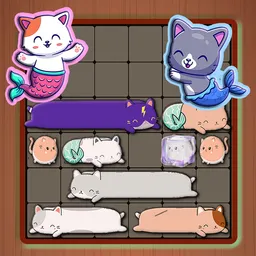








Good Sort Master: Triple Match is a shelf-organising puzzle. Each level presents a wooden shelf grid with items scattered across its compartments: mugs, fruit, toys, bottles, whatever the current set happens to be. You drag an item from one compartment to another, and whenever three identical items sit on the same shelf they vanish. Empty every compartment and the level is done. There is no timer, no move counter in the usual sense and no opponent; the only pressure is the limited number of free slots that constrain where you can put things.
The format grew out of the triple-match wave that followed Triple Tile and the many goods-sorting games on mobile, where the appeal is the same as tidying a cupboard: a satisfying moment every time a trio disappears, and a small calculation before each move about which slot to free next. Good Sort Master: Triple Match keeps that appeal and removes the stress elements that some of those games add, such as countdowns and lives, which is exactly why it carries the Cosy category alongside Puzzle.
A session is a sequence of short levels. Early boards have only eight to twelve items with plenty of empty space, so you can move freely and learn how shelves clear. As you progress the grids get denser, with twenty or more objects and very few spare compartments, and the puzzle turns into something closer to a sliding block game: you must plan which trio to complete first so that the space it frees makes the next trio possible. Finishing levels unlocks new item sets, which keeps the look fresh without changing the rule.
What distinguishes it from a generic match-3 is that nothing happens automatically. In a swap-based puzzle the board cascades and surprises you; here every clearance is one you built deliberately, and a stuck board is always the result of your own ordering rather than bad luck with falling pieces. That makes it a thinking game at a very low intensity, closer to solitaire than to an arcade puzzle. The absence of a timer reinforces that: you can leave a half-sorted shelf on screen, come back, and the board is exactly as you left it.
It suits anyone who wants a puzzle they can play with one hand and stop at any moment. The description pitches it as relaxing for women and men alike, and in practice it is also fine for children, since the content is household objects and the rule can be shown in a single drag. People who enjoy sorting games, hidden-object scenes or the satisfaction of a cleared inventory will find it immediately familiar, and the short levels make it easy to fit into a few spare minutes.