 LemonArcade





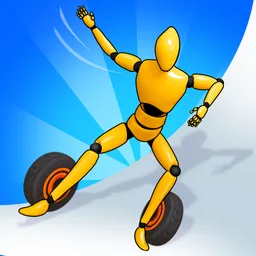





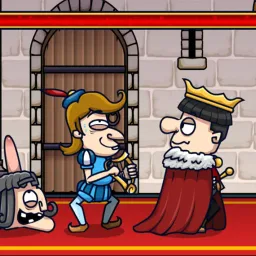










Ragdoll Crash-Test: Throw and Break is a physics game by Popik in which the only thing you ever do is throw. Each stage hands you a floppy stickman, a screen full of hazards — cannons, bear traps, a passing train, a lava pit — and an implicit target for how much damage the throw should produce. You drag to set direction and force, release, and then watch. Everything after the release belongs to the physics engine.
That division of labour is what makes it a puzzle rather than an action game, despite the wreckage. Your entire influence is spent in the second before the throw: the angle, the strength, the choice of which hazard to hit first. The stage is a question, the trajectory is your answer, and the simulation grades it. When a throw goes wrong there is no recovery input, no mid-air steering — you read the result, adjust one variable, and throw again. It is closer in structure to a golf shot or an Angry Birds turn than to anything you pilot.
The hazards are the vocabulary the puzzles are written in, and each behaves differently on contact. A cannon relaunches the ragdoll across the screen, converting one throw into two. A bear trap holds him in place while damage accrues. Spikes, lasers and carnivorous plants each pay out differently depending on the speed and angle of arrival. The interesting stages are the ones where no single hazard is worth enough on its own, so the throw has to be routed — into the cannon, off the wall, onto the spikes — turning aiming into a small piece of bank-shot planning.
Later stages stack these elements into combinations with narrower tolerances, and moving hazards like the train add a timing component on top of the geometry. The ragdoll itself is a source of honest noise: because limbs flail and catch on edges, two near-identical throws can diverge, which teaches you to aim for robust solutions — trajectories that succeed across small errors — rather than one perfect pixel. That is a genuinely transferable habit, and the game builds it without ever announcing it.
LemonArcade files it under Casual and Puzzle, and the pairing is earned: Casual because a round is one drag and a few seconds of consequences, Puzzle because the drag is a considered answer rather than a reflex. The developer publishes under the Popik label and distributes through Playhop, where the game carries a 12+ rating — the violence is cartoon stickman slapstick, rendered in bright toy colours. It suits short sessions on any machine with a mouse or a touchscreen, which in practice includes the school Chromebook.