 LemonArcade

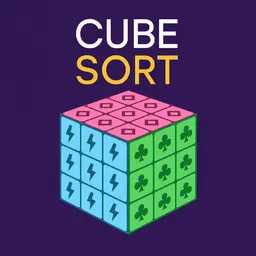


























Arrow Cube 3D is a spatial logic puzzle from Green Train, a three-person independent studio made up of a developer, a producer and a UI designer who spent years on mobile games before switching to the web. The game arrived in May 2026 through Playgama's distribution network and reached YouTube Playables at the end of that summer, where the studio has described it as one of their strongest performers. It is built in the Defold engine and the whole core download weighs around 3 MB, which is why it starts almost instantly even on a slow connection. The studio has said in interviews that the small size was a deliberate choice, since YouTube's platform caps the initial load and rejects games that exceed it.
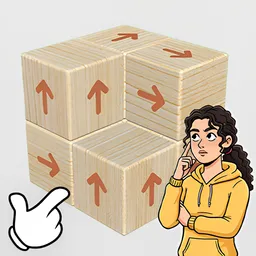
Each level hands you a cube whose six faces are tiled with arrows. Tapping an arrow slides it off the cube in the direction it points, but only if nothing sits in its way. Most arrows are blocked at the start, so the real work is rotating the cube, tracing where each arrow would travel and finding the few pieces that can leave right now. Removing one frees the next, and the level ends when the last arrow slides away. There is no move limit and no clock, just the order. A wrong tap does nothing at all, which means the game never punishes you for testing a hunch, and the only cost of a mistake is the time it takes to turn the cube and look again.
The trap the game sets is that arrows wrap around edges. A piece that looks free on the front face may be pointing into a tile on the top face that you cannot see from your current angle, and the only way to know is to turn the cube and check. Later boards pack arrows into head-on pairs and long parallel chains, so a single wrong assumption leaves you tapping pieces that refuse to move. According to the studio, the first twenty to forty levels were designed by hand and the rest are generated, which is why the difficulty climbs steadily instead of in jumps. The generated boards also tend to hide the starting arrow on the face you are least likely to look at, usually the bottom.
Beyond the puzzles themselves there is a daily leaderboard that ranks players on how far they got, and the game has been translated into fourteen languages including Japanese, Korean, Thai and Turkish. What it deliberately lacks is any pressure: no lives, no energy meter and no timer. That makes it closer to a physical toy than to the usual free puzzle app, and it explains the studio's own figure that average sessions run past thirty minutes on several platforms. The presentation follows the same idea, with a plain backdrop, soft colours on the arrows and a short animation as each piece slides off, so nothing competes with the cube for attention.
It suits anyone who likes Tap Away style unblocking puzzles but wants the extra dimension of a full cube rather than a flat grid, and it works just as well as a five-minute break as it does for a long stretch. Players who need a score chase or a timer to stay engaged may find it too quiet. It is also a decent choice for people who struggle with 3D games in general, because the cube only ever rotates, never moves through space, and the camera always keeps the whole object in view.
On LemonArcade it runs free in the browser with no download or account. Touch controls are native, so it plays comfortably on a phone by swiping to rotate and tapping to remove, and the small download makes it one of the quickest games on the site to load. Levels take one to five minutes each and the early ones are gentle, so expect the challenge to build only after the hand-made set is behind you. Progress is kept in the browser rather than on an account, so stick to one device if you want to keep your level count.