 LemonArcade










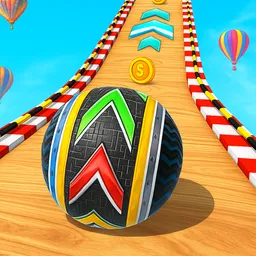













Neon Ball Slope is LemonArcade's own listing of Slope, the minimalist 3D ball-rolling game created by designer Rob Kay and published by Y8 Games on September 30, 2014. Kay had already made his name as lead designer on Guitar Hero and Rock Band before turning to small, skill-first WebGL browser experiments, and he first put Slope on Kongregate under the handle robkaySF before Y8 picked it up. More than a decade later it remains one of the most played browser games in existence — Y8 alone reports over 141 million plays — and the name Neon Ball Slope refers to the same game, not a separate remake.
The loop is deliberately small: a glowing ball rolls down a steep neon corridor, and you steer it left and right to avoid red obstacles and gaps while speed climbs continuously. There is no story, no menu of modes and no upgrade system between runs — every attempt is the same rule set applied to a freshly generated course, and the only thing that changes run to run is how far your reactions carry you before a single mistake ends it.
What makes it distinctive is how little it asks you to learn before it starts testing you. Kay has described wanting to build "pure gameplay" that needs no tutorial, and Slope delivers on that: the controls are explained in one line and the entire skill ceiling comes down to reflexes plus restraint, since the Down key lets you deliberately brake through a dangerous cluster instead of only ever holding full speed. Courses are procedurally generated, so memorizing a layout never helps — every run is a fresh read-and-react test rather than a track you can learn by heart.
That format suits arcade and reflex players specifically, and it especially rewards the kind of player who treats a high score as the whole point rather than a side effect — a scene of speedrunners and score-chasers has built up around Slope precisely because a personal best is the only progression the game offers. It is a poor fit for anyone looking for a longer session with checkpoints or a narrative hook; it is exactly right for someone who wants to lose two or three minutes at a time trying to beat their own last run.
The game did not stay static after its 2014 launch. Through 2015 and 2016 it received iterative updates — new obstacle patterns, smoother controls, procedural generation tweaks, plus speed boosters and tunnel sections added to keep a game with no other content additions feeling fresh. Those updates are part of why the same core build from a decade ago still holds up as a genre staple rather than reading as dated.
On LemonArcade it runs free in the browser with no download and no account. The listing here supports desktop with keyboard steering; a touch tap control is offered but the precision the fast pace demands is noticeably easier with a keyboard, so treat mobile play as a fallback rather than the intended way in. Sessions run from a few seconds to a couple of minutes per attempt, and the difficulty is unforgiving by design — the entire appeal rests on that gap between feeling unfair on your first run and feeling genuinely learnable by your fiftieth attempt.