 LemonArcade



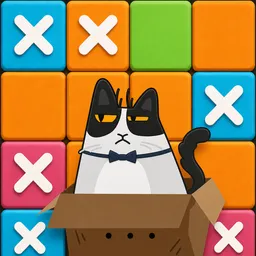

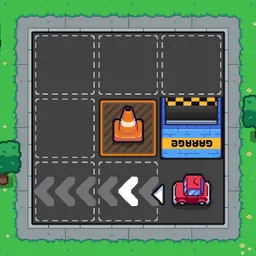















Block Escape: Brain Training is a sliding block puzzle, the genre that traces back to a wooden puzzle called Klotski and reached most people through the mobile game Unblock Me. The board is a grid crowded with rectangular blocks. One of them is yours, and there is an exit on one side. Blocks only slide along their own axis — horizontal pieces move left and right, vertical pieces up and down — and none of them can be rotated or lifted out.
That single constraint is what makes the puzzle work. You cannot move your block to the exit because something is in the way; you cannot move the obstruction because something is behind it; and clearing that requires shifting a third piece that only has room if you first move a fourth. Solving a board is less about seeing the answer than about unwinding a chain of dependencies in the right order.
The difficulty curve is honest. Early boards have obvious solutions and exist to teach the movement rules. Later ones are built specifically to defeat the intuitive approach — the move that most obviously helps is often the move that locks the board, and the correct opening frequently looks like it makes things worse. Working backwards from the exit is a far more reliable method than working forwards from your block.
There is no time pressure and no fail state, which places this squarely in the brain-training corner of the puzzle genre rather than the arcade one. You can stare at a board for as long as you like, and a wrong move costs you only the moves needed to undo it. That makes it a genuinely low-stress game despite the difficulty of individual levels.
The genre has a mathematical pedigree worth knowing about: sliding block puzzles of this general kind are computationally hard, and the minimum number of moves for a given configuration is not something you can work out by inspection. When a board feels disproportionately difficult for its size, that is often accurate rather than a failure of insight.
Block Escape: Brain Training is developed by Cocos Labs and distributed through Playhop, the Yandex games platform. It runs in a browser tab with no install and plays well on both desktop and touchscreen, since the only input is dragging a block along its axis. Playhop plays a short advertisement before the game starts, which is how the platform pays the developer.