 LemonArcade

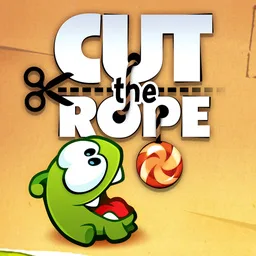
























Cut the Rope 2 is ZeptoLab's 2013 answer to a hard design question: how do you follow a puzzle game whose whole identity was a single gesture? The original gave you a swipe that cuts and a physics simulation that does the rest. A sequel that added buttons or menus would have broken the promise; a sequel that added nothing would have been a level pack. The answer the studio chose was to keep the finger's job identical and put all the novelty into the world the finger acts on.
The most visible change is that Om Nom leaves the cardboard box. Where the first game framed every puzzle inside a shipping crate, the sequel sends its candy-eating hero on a journey through outdoor scenes — a forest, a dam of sand, a junkyard and beyond — chasing candy stolen at the start of the story. The scenery shift is more than backdrop: open environments give the designers ground, walls and ceilings to build on, and Om Nom himself can now hop between spots instead of waiting at a fixed point, which quietly removes the original's one constant.
The real structural addition is the Nommies, a cast of creatures who each embody one mechanic. Roto is a flier that carries Om Nom or the candy to a new position. Lick makes small bridges with his tongue. Blue lifts Om Nom upward. Toss throws objects, candy included. Boo startles Om Nom into jumping, and Snailbrow rolls along walls and ceilings, pushing candy as he goes. In first-game terms, each Nommie is a new verb — but a verb that lives in the level as a character rather than as a gadget, activated by the same taps and swipes as everything else.
That is the sequel's cleverest move. Cut the Rope 1 expanded its vocabulary with objects: bubbles, cushions, hooks. Cut the Rope 2 expands it with actors who have positions, movement and timing of their own, so puzzles gain a choreography layer — you are not just choosing cut order any more, you are sequencing the cast. A level might require Snailbrow to ferry the candy across a ceiling before a Roto repositions Om Nom to catch it, all still driven by one finger.
The game reaches LemonArcade in browser form via Famobi's HTML5 catalogue on Playhop, with mouse input standing in for touch. It sits in Puzzle and Casual for the same reasons its predecessor does: short self-contained levels, a three-star chase for players who want depth, and no failure cost beyond an instant retry.