 LemonArcade


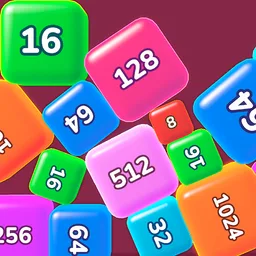
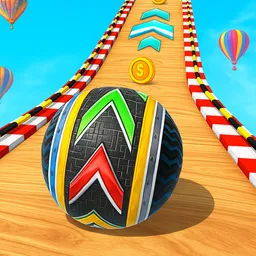




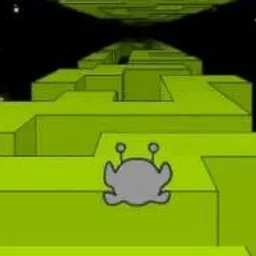













Ball Run 2048 Space is a lane runner where the thing you are steering is a number. Your ball rolls forward along a track suspended in space, carrying a value on its surface, and the track is scattered with other numbered balls. Roll into one that matches your value and the two merge, doubling your number the way tiles do in 2048. Roll into a spike or an obstacle and you lose value or the run. The goal of each level is to reach the finish line with the biggest number you can, with 2048 as the figure the game holds up as the ultimate ball.
Controls are deliberately thin: on desktop you move the mouse left and right to change lane, on a phone you drag your finger. There is no jump, no brake and no button to merge; everything is decided by which lane you occupy when the next cluster of balls or hazards arrives. A run lasts a minute or two, the track speeds up as it goes, and the decisions pile up quickly because a lane that holds a matching ball now may hold spikes right after it. Reading the track ahead is the whole skill.
The format is a mash-up of two very recognisable ideas. The merging rule comes from 2048, the 2014 sliding-tile puzzle where equal numbers combine into their sum. The lane running and swipe steering come from the hyper-casual runner wave of the late 2010s. The combination, a rolling ball that merges numbers on a track, became its own small genre on mobile around 2021 with games such as KAYAC's Ball Run 2048, and Ball Run 2048 Space is a separate game in that same format, distinguished by its space setting and its lane-based obstacle courses.
It is a quick-session game for players who like runners but want a little arithmetic in the mix, and for 2048 fans who want the merging feeling without a grid. Children can play it easily, since the rule is simply match the same number, while adults will enjoy the growing tension of carrying a big value into a hazard-filled stretch. LemonArcade files it under Arcade, Platformer and 3D: an arcade runner at heart, built around platforms over space, rendered in three dimensions.