 LemonArcade






















Evolution 2D Lake is a top-down ecosystem simulation set in a procedurally generated body of water. You start as a single cell near the bottom of the food chain, and the goal is exactly what the premise implies: eat, grow, and climb until nothing in the lake preys on you. What separates it from the usual eat-and-grow game is that you do not unlock a fixed ladder of predefined animals — you design your own organism in an editor, piece by piece, and every design decision changes how the creature behaves in the water.
The editor is the centre of the game. Parts include jaws for biting, spikes for defence, photosynthetic pigments that generate energy passively, and jet accelerators for burst movement, and each one alters how your cell handles rather than just how it looks. The crucial rule is that parts must be built in the editor before they exist in the water, and building them costs resources you have already gathered. That single decision turns the game from a reflex exercise into a planning one: an editor session is a spending decision, and a bad build is something you swim around in until you can afford to fix it.
The resource system gives the lake a geography. Five minerals — phosphorus, sulfur, calcium, salt and iron — are scattered across distinct habitat zones, and the minimap shows both where each resource concentrates and what kind of creatures hold that territory. Read together, those two layers price every trip: the richest deposits tend to sit in water patrolled by fauna that can eat you, so progress is a series of judgements about which zone your current build can survive.
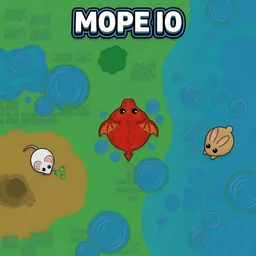
Its lineage runs through the aquatic evolution games that came before it. flOw established the abstract swim-and-consume loop in 2006, Spore's cell stage turned it into a creature-editing prologue in 2008, Feeding Frenzy and Tasty Blue built whole games out of eat-and-grow, and Deeeep.io mapped a food chain onto multiplayer. Evolution 2D Lake takes the Spore half of that inheritance — edit, release, hunt, return to edit — and makes it the entire game rather than a first act, then bolts on a mineral economy none of those predecessors had.
It carries Sandbox and 2D as categories and both are accurate. There is no mission structure pushing you forward; the lake is a space you learn, and the food chain is a problem you solve with builds rather than a ladder you are walked up. Rated 6+ and running directly in the browser with nothing to install, it suits the player who liked the idea of Spore's cell stage more than its execution — someone who wants to sit with the editor, test a theory in the water, and come back with a better one.