 LemonArcade














Mine - Online is a 3D sandbox in the familiar language of cubes: you play Noob the miner, dropped into a blocky world shared with other real players, where the ground comes apart under your pickaxe and goes back together as whatever you decide to build. Final Tale publishes it through Playhop, and the whole thing runs in a browser tab — a multiplayer voxel world with no download and no account standing between you and the dirt.
Browser Minecraft-likes are exercises in deciding what the formula can afford to lose. Mine - Online keeps the verbs — dig, place, build, survive — and the fundamental exchange they add up to: terrain becomes material, material becomes safety. What it sheds is the freight: the enormous crafting trees, the layered machinery, the infinite terrain generation that make the original a hundred-hour game and a multi-gigabyte install. The wager is that the core loop was never carried by content volume, and it mostly pays off — a few minutes of digging toward a shelter feels the way it always has, even in a world with far fewer kinds of block.
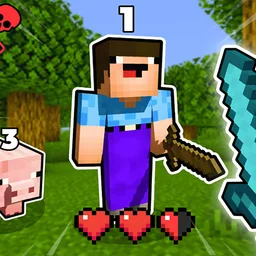
Naming the player character Noob is a wink at a specific corner of the internet. Minecraft animation channels on YouTube turned the Noob — the earnest, doomed beginner whose plans go sideways — into one of the most-watched stock characters in children's media. Casting you as him does something gentle to the game's social temperature: everyone on the server is officially a Noob, nobody's lopsided first dirt hut is embarrassing, and the fiction quietly grants permission to not know what you are doing yet.
The word Online carries the most weight in the title, because other players change what every mechanic means. A shelter in a solo sandbox protects you from the game; a shelter on a shared server also protects your work from people. Open building spaces have run the same experiment since the earliest Minecraft servers — some strangers add a wall to your house, others remove your house — and this game hands you both roles and almost no rules. Learning to build slightly out of the way, to judge whether an approaching player is a collaborator, and to shrug off the occasional demolition is the real curriculum, and for young players it is a useful first lesson in sharing an unsupervised commons.
It sits under Sandbox and Multiplayer on LemonArcade, with a 12+ rating from its distributor, and the second label is the one to take seriously: alone, this is a modest building toy, but on a populated server it becomes a small society with a society's friction. It is also pitched at exactly the hardware its audience owns — a shared voxel world light enough for a school Chromebook to lift.