 LemonArcade
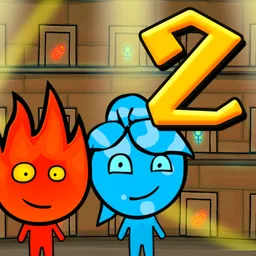

























Fireboy and Watergirl in the Forest Temple is the game that started one of the longest-running series in browser gaming. It was made by a single developer, Oslo Albet, and released as a Flash game on Armor Games on 19 November 2009. Nothing about it was flashy: two small characters, a set of stone rooms, and a rule so simple it fits on one line. Fireboy can wade through lava but dies in water, Watergirl can swim through water but dies in lava, and the green goo kills both of them. From that rule Albet built 32 levels, and from those 32 levels grew a franchise that now spans seven main temples and multiple app-store releases.
Every level has the same goal. Both characters must reach their own exit door, red for Fireboy and blue for Watergirl, and the level only ends when both are standing in front of them at the same time. Along the way you pick up red and blue diamonds, each colour reserved for the matching character, and the game grades you on time when you finish. Getting there means using each character's immunity to open the way for the other: Fireboy crosses a lava pit to step on a button that raises a platform, Watergirl swims through a pool to pull a lever that unlocks a door. The Forest Temple is the gentlest of the series, so its puzzles lean on levers, pressure plates, elevators and pushable boxes rather than the light beams and ice physics that later temples introduced.
The controls are the reason this game became a schoolyard fixture. Watergirl moves with the arrow keys and Fireboy with WASD, and both sets of keys are live at the same time, so two people can sit at one keyboard and each take a character. That co-op mode is where the game shines: one player holds a button while the other runs, one waits on a platform while the other finds the lever, and the timing mistakes are as much fun as the successes. Playing solo is entirely possible and is how many people first experienced it, but it turns the game into a different puzzle where you move one character, park them safely, then switch your attention to the other.
What keeps it interesting across all 32 rooms is that the difficulty comes from sequencing rather than from reflexes. Jumps are forgiving, characters are slow, and nothing chases you. The challenge is working out the order of operations: which character needs to be where before a platform is triggered, whether a box needs to go into a pool to make a bridge, and how to get both characters back to their doors once the mechanism has been used. The time-based ranking adds a replay layer for people who want it, but the game never forces speed on you.
The series that followed kept the formula and changed the environment. The Light Temple in 2010 added mirrors and light beams, the Ice Temple in 2012 added slippery floors, the Crystal Temple in 2014 added teleporting crystals, and Elements, Fairy Tales and Friends carried the pair from 2018 to 2026, including releases on mobile and Steam. When Flash reached the end of its life, the original was rebuilt in HTML5 so it could keep running in modern browsers, and that is the version served here. Reviews of the original were fair rather than glowing, praising the level count and pacing while noting it was never meant to compete with deeper platformers, which is roughly how it still feels: modest, well-made, and instantly readable.
On LemonArcade the Forest Temple runs free in the browser with no download and no account. It is a keyboard game at heart, and because two players share one keyboard it is listed for desktop rather than phones. A full run of all 32 levels takes roughly an hour for a pair who know what they are doing and longer for first-timers, though each level is a self-contained two to four minutes, so you can stop at any point. Difficulty is low in the opening rooms and moderate by the end; it is one of the easiest entries in the series and the right place to start before the Light or Ice Temple.