 LemonArcade

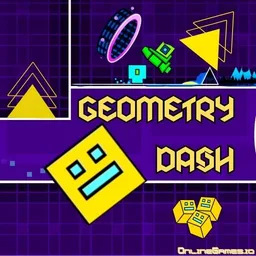
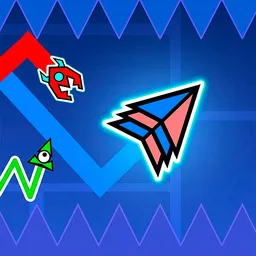














Geometry Dash Scratch is what happens when the hardest one-button game of the 2010s gets rebuilt inside a children's coding tool. Geometry Dash itself is Robert Topala's game, released by his studio RobTop in August 2013, a rhythm platformer in which a cube slides across the screen at fixed speed while you jump over spikes to the beat. Scratch is the block-based programming environment from MIT, mostly used in classrooms. In April 2016 a Scratch programmer known as griffpatch published a remake of the first three levels, and it grew into one of the most viewed projects in Scratch history, with tens of millions of plays and a wave of remixes adding more levels, practice mode and new features.
The version hosted here belongs to that family of Scratch-built recreations, packaged so it runs as a normal web page. Portal listings credit a creator called Duck, and there is no evidence it is an official RobTop product, so treat it as a fan remake. What it reproduces is the original's opening trio: Stereo Madness, the level that teaches cube jumping and introduces the ship section, Back on Track with its yellow jump pads, and Polargeist, where yellow rings ask you to press at the exact moment you touch them. Each level plays to the same electronic tracks as the original and the obstacle layouts follow the source closely enough that a player who knows the real game can clear them from memory.
The rules are simple to state. The cube moves on its own; you press space, the up arrow, W, a click or a tap to jump. In ship sections the input becomes a hold that lifts you and a release that drops you, so the challenge switches from timing to steering through gaps. Gravity portals flip you to the ceiling, and jump pads and rings launch you higher than a normal hop. Touch a spike or a block face and the level restarts from zero, with a progress percentage recording how far you got. That percentage is the whole progression system: the goal is simply to see it read 100.
What separates it from a generic runner is the music. Every jump in these levels lines up with a beat, and after a few attempts players stop reading the screen and start jumping to the song, which is why a full clear feels like performing a track rather than dodging obstacles. Scratch imposes some limits, notably a lower frame rate and simpler effects than the original, but the spacing of the obstacles is what matters and that survives.
It suits people who know the real thing and want it on a machine that cannot install it, which in practice means school Chromebooks, and people who have watched Geometry Dash videos and want to find out how brutal a supposedly easy level is. The first three levels are rated at the bottom of the original's difficulty scale, yet most newcomers need dozens of attempts to clear Stereo Madness.
On LemonArcade the game is free in the browser with no download or account. It responds to keyboard, mouse and touch, so it works on phones as well as desktops, though a big screen makes the spike gaps easier to read. A level takes roughly ninety seconds when you clear it, and a typical session is many short failures. Because Scratch projects are interpreted rather than compiled, older devices may drop frames, which will make timing feel off; closing other tabs helps.