 LemonArcade























Slither.io was released on 25 March 2016 by American developer Steve Howse, working through his studio Lowtech Studios, and it became one of the defining internet phenomena of that year. Within months it had peaked at roughly 60 million monthly active users and reportedly generated over $100 million in advertising revenue in its first year. Coverage from PewDiePie and other large YouTube channels turned a simple browser game into a genuine cultural moment, and iOS and Android versions followed in May 2016.
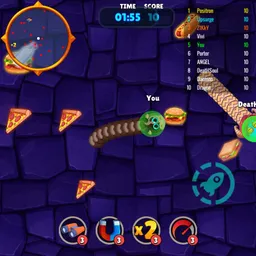
The design is famously spare. You are a snake. You eat glowing pellets and you get longer. If your head touches another snake's body, you die instantly and burst into a trail of pellets for everyone else to eat. That is the entire rule set, and it is enough — because the interesting consequence of those rules is that size is not safety. A giant snake is a giant obstacle course of its own body, and length makes turning slower and collisions easier.
What emerged from those rules is a genuine competitive metagame. The core aggressive move is the cut-off: you accelerate past a snake, swing your body across the path in front of their head, and let them run into you. Do it well and you inherit their entire length in pellets. The counter is equally simple to describe and hard to execute — read the cut-off early, brake by releasing boost, and turn inside their arc.
Boosting is the risk-reward mechanic that keeps the game from being solved. Holding boost makes you faster, which is how you set up cut-offs and how you escape them, but it continuously burns your own length. Every aggressive play costs you mass whether it works or not. Newer players boost constantly and stay small; experienced players boost in short, decisive bursts and only when the pay-off is already visible.
Slither.io also produced one of the great pieces of .io folklore: the coiling defence. Surrounded by larger snakes, a small snake can wind itself into a tight spiral, becoming almost impossible to cut off because it has no exposed head-to-body approach. It is slow, boring and highly effective, and the community has argued about whether it is legitimate strategy or cowardice for nearly a decade.
The game remains free, runs in a browser tab, and works genuinely well on a touchscreen — steering by dragging is if anything more intuitive than steering by mouse. There is no account, no progression, and no unlock system beyond cosmetic skins. You start at zero every match, which is exactly why it has aged so much better than most of what followed it.