 LemonArcade



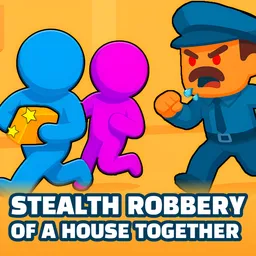
























Stealth Robbery of a House Together is a cooperative heist game for two players sharing one keyboard. You and a partner break into a furnished house, pick up whatever valuables you can reach, and carry them out to the getaway van before the level timer runs out. Guards patrol the rooms sweeping flashlights, cameras cover fixed angles, and the quiet part of the evening ends the instant either of you steps into a beam. One player moves on WASD, the other on the arrow keys, and the same game runs on touch screens.
Stealth games are almost always built for one player, and there is a structural reason for that: the genre's core resource is attention. A solo sneaker tracks patrol routes, listens for footsteps and plans a path, and the whole game is about how much of that picture they can hold at once. Putting two burglars in the house doubles the number of bodies that can be spotted while halving the attention each player can spend on their own position — you are always half-watching your partner's corner of the screen, because their mistake ends your run too.
The decision that actually matters here is not how to sneak — the movement is deliberately simple — but how much to carry out. Some valuables sit near the exit and cost almost nothing to take. Others sit deep inside the patrol routes, behind a camera or a room a guard never fully leaves. Since the haul only counts once it reaches the van, every extra item is a bet: the score for grabbing it against the run you lose if the detour gets one of you caught. That risk-against-greed structure is the classic heist tradeoff, and the timer keeps you from resolving it by simply waiting out every patrol.
Co-op changes what the guards mean, too. Alone, a patrolling guard is an obstacle to route around. With a partner, he becomes something you can manage: one player shows themselves at the edge of a room or makes noise near the furniture, pulling the patrol out of position while the other walks through the space it just vacated. The game does not force this kind of play, but the levels reward pairs who talk, and sitting at the same keyboard makes the talking free.
It is filed under 2 Players and Casual, and both labels are earned. Levels are short, failure costs a retry rather than progress, and the controls are two direction schemes with nothing to memorise. The audience it fits best is exactly the one that plays it most: two people at one machine — classmates on a shared Chromebook, siblings on the family computer — who want a game where cooperation is the mechanic rather than a chat feature bolted onto a solo design.