 LemonArcade

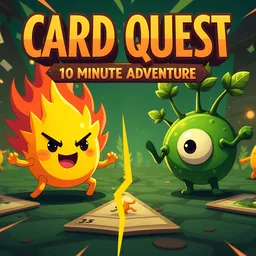
























Card Quest builds its entire ruleset on Triple Triad, the card minigame Square introduced inside Final Fantasy VIII in 1999 that became beloved enough to spawn its own standalone mobile release and a wave of imitators years after the main RPG faded from conversation. The core idea travels well outside its original game: each card carries four numbers, one per side, and placing a card next to an opponent's on a small grid lets the higher number flip the lower one to your color. Card Quest keeps that rule intact and wraps a fantasy campaign map and a monster-collecting hook around it. No public developer credit could be confirmed for this build beyond Playgama as distributor, so the studio behind it is not identified here. That the mechanic has been ported this many times, across official spin-offs and independent fan projects alike, says something about how little the original needed changing to work as a standalone game — a small grid and four numbers per card is close to a complete ruleset on its own.
Where the original minigame was a diversion inside a much larger RPG, Card Quest makes the ruleset the entire game. You move across a campaign map fighting a sequence of opponents, and each one changes the terms slightly: different card decks, different board sizes, and occasionally special rules layered on top of the base flip mechanic, echoing the regional rule variants that made the source game's card scene famous among its own players. That structure gives the campaign a shape closer to a string of boss fights than a single long match, since each node is a discrete puzzle built around whatever twist that particular opponent brings.
The collection layer is the game's second pull. Beating an opponent doesn't just clear a node on the map, it can win you their cards, and a persistent collection book tracks every uniquely illustrated fairy-monster card you've acquired across the run. That framing turns a string of individual matches into a longer-term goal: completionists have a reason to replay tougher opponents for the one card still missing from the book.
The numbers-and-flipping core is simple to explain but leaves real room for combo play once a board fills up. Placing a card that flips one enemy card can trigger a chain if that flip changes the numbers facing its other neighbors too, so a single well-timed placement can swing three or four cards at once. The description's own warning is accurate to the genre: opponents can flip your cards right back, so a strong opening position can collapse in a single enemy turn if you don't account for what your placement exposes.
It suits players who already like turn-based strategy in small doses — chess-adjacent thinking without chess's time investment — more than it suits anyone looking for reflex-based card action. Early opponents are lenient about mistakes; later ones on the campaign map bring larger decks and stricter rule twists that punish a placement made without checking what it exposes on the next turn. The fantasy art direction and monster theming give the whole campaign a lighter, more whimsical tone than the source minigame's card-table backdrop, which makes it an easier entry point for players who never touched the RPG it borrows from.
On LemonArcade, Card Quest runs free in the browser on desktop or mobile with no download or account, and it's built with unusually broad language support, including Chinese, German, Spanish, French, Japanese, Korean and Russian alongside English. A single match runs a few minutes; the full campaign is considerably longer, since the difficulty and card variety both scale as the map progresses.