 LemonArcade












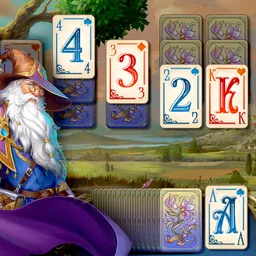








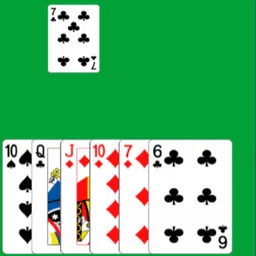


Magic Tri Peaks Solitaire is built on TriPeaks solitaire, a single-player card variant that arranges the deck into three overlapping pyramids and asks you to clear it one card at a time, each removed card needing to be exactly one rank higher or lower than the last. Playgama credits the developer as Rainbow Games (Andrey Mesheryakov), a studio with roughly ten titles on the platform, and this is one of several TriPeaks builds it has released, wrapped here in a fantasy-journey theme. Releasing more than one TriPeaks variant under different themes is a common approach for solitaire-focused studios, since the underlying rules and interface can be reused while the art, level pacing and bonus mechanics change from one title to the next.
The base rule is unchanged from the solitaire format that spread through Windows and casino software in the 1990s and 2000s: you draw from a stock pile, and any exposed card on the peaks that sits one rank above or below the current draw can be tapped away, chaining as long as the sequence holds. What resets that chain — running out of valid moves before the peaks are clear — is the same failure state every TriPeaks version shares, and it's why the format rewards reading the board ahead rather than clearing the easiest card available each turn. A long chain is also the main source of score in this style of solitaire, so a player who clears cards in whatever order keeps the run alive typically outperforms one who grabs the highest-value card visible at each step.
The fantasy wrapper is more than decoration. Levels are strung across named locations — forests, mountains, seas, snowy peaks — and periodically stage what the game calls battles against elemental golems, giving stretches of otherwise repetitive card-clearing an actual sense of place and escalation as you move further into the map.
The mechanical layer that separates this from a plain TriPeaks clone is its booster set. A Joker accepts any card from the board regardless of sequence, the Combo booster hands you a five-card chain at a level's start, Eye reveals the next card in the stock pile before you draw it, Sword lets you swap a stock card for one you actually need, Bow removes a chosen card from the board outright, Fan reshuffles the deck to surface something useful, and Hammer flips over a section of face-down cards. None of these are available without limit, so using one well on a stuck board matters more than hoarding them.
It suits players who already like solitaire's meditative pace but want more to manage than a bare deck — the boosters add a light resource-management layer on top of the sequencing puzzle, and the hundreds of levels mean the difficulty and card layouts keep shifting well past what a single sitting will cover. Compared with a bare-bones TriPeaks app, the fantasy map and golem encounters give the long level count a visible sense of progress that a plain, undecorated stack of levels usually lacks.
On LemonArcade it runs free in the browser on desktop or mobile, no download or account required, in English, German, French and Russian. A single level takes a few minutes; the difficulty climbs gradually as later locations introduce tighter peak layouts and tougher golem battles, and while the game lists no in-game purchases, the finite booster supply means later levels do ask for more careful sequencing than the early ones.