 LemonArcade






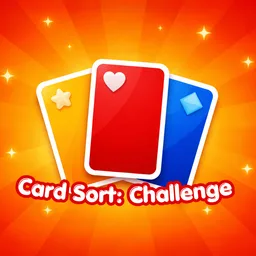












Sort It Out: Category Sort takes the tabletop card-sorting puzzle and turns it into a head-to-head race against the clock. Playgama distributes the game, and while a same-named title exists elsewhere on itch.io, its description points to a different kind of game entirely, so no developer credit can be confirmed for this specific build — it's stated here rather than guessed at. What is clear from the game itself is the format: a wooden tabletop grid, stacks of icon cards, and ninety seconds to out-sort a rival doing the exact same puzzle beside you. That combination of sorting mechanics with a competitive timer is closer to a party game than to the single-player categorization apps the same basic idea usually appears in.
The board is a five-by-four grid where most cells hold a stack of mixed cards — animals, food, tech, sports icons and more — but only the top card of each stack can be grabbed at any time. A handful of cells are gold goal slots labeled with a category and a target count, like Animals at zero of six, and dropping a matching card there ticks it toward completion. A shelf of five free slots along the bottom exists purely as temporary storage, letting you set aside a card you can't use yet to reach whatever is buried underneath it in a stack.
Each match runs exactly ninety seconds and covers three categories at once, with five to seven cards per category depending on difficulty, so a session is a tight burst of decision-making rather than a slow puzzle to mull over. Whoever completes more full categories when the timer hits zero wins, and ties favor the player rather than the opponent, which keeps close matches from feeling like wasted effort.
The head-to-head structure is what separates this from a standard solo sorting puzzle. You and your rival work identical boards side by side, which turns a category-matching exercise into something closer to a speed duel: every second spent digging through the wrong stack is a second your opponent gets to pull ahead, and the shelf becomes a real resource-management decision rather than a convenience, since filling it up with cards you're not ready to use costs you options later in the same ninety seconds.
It suits players who like their puzzles fast and a little competitive rather than meditative — closer in pace to a quick reflex game than to a slow solitaire session, even though the underlying task, sorting icons into the right bucket, is simple enough for a much younger audience to follow immediately. There's no strategic depth beyond speed and stack management, and that's by design; the whole match is over before a slower-paced puzzle would even finish its first round.
On LemonArcade it runs free in the browser on desktop or mobile with mouse or touch controls, no download or account needed. A full match takes ninety seconds plus a few seconds to read the board, so it plays well as a quick one-off or a repeated best-of-three against the clock, and the fixed timer means the difficulty comes entirely from card count and category complexity rather than from any adjustable setting. There's no in-game purchase to buy extra time or an easier board, so every win comes from actually sorting faster than the rival, not from spending anything.