 LemonArcade










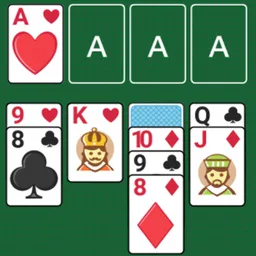









Stackitaire, credited on its official Playgama listing to developer John Hany, takes the suit-sorting instinct behind classic solitaire's foundation piles — the same urge that drives Klondike toward four neat ace-to-king stacks — and turns it into a standalone sorting puzzle. There is no deal, no draw pile and no reshuffle here. Every level is a fixed, hand-built layout of mixed-up card stacks that you have to untangle through pure planning, which puts it closer in spirit to the 'sort matching items into groups' puzzle genre popularized by games like Water Sort than to a dealt hand of solitaire.
The core loop is simple to state and harder to execute well. Tap a stack to lift its top card, then tap another stack to place it there. A card can only land on another card of the same suit, or into a stack that is completely empty. A stack is considered finished once it holds every card of one suit stacked in order from bottom to top, and a level ends the moment every stack on the board has been cleared this way. Because nothing about a layout changes once the level starts, a position either has a solution reachable through careful sequencing or it does not.
Difficulty is added level by level rather than through timers or randomness. Hundreds of layouts escalate by introducing locked cards that need a specific action to free, hidden decks whose contents stay unknown until you uncover them, and progressively tighter stacks with less room to maneuver. Three named boosters run through the whole set to help when a layout gets away from you: Undo takes back a bad placement, Hint highlights the strongest next move, and Key is used specifically to unlock a sealed stack and flip its hidden cards face up.
What sets Stackitaire apart from ordinary solitaire is the absence of luck at any point after a level loads. There is no stock pile to draw from, no chance of a helpful card turning up later — everything you will ever need is already visible or waiting behind a lock from the first tap. That makes it a genuinely different kind of challenge from shuffle-based card games: less about adapting to a random hand and more about reading a closed puzzle correctly the first time, or backtracking cleanly when you read it wrong.
It suits players who like the suit-sorting goal of classic solitaire but want a self-contained puzzle rather than a full-deck deal, and it also appeals to fans of sorting puzzles generally, regardless of whether they care about card games at all — the suits here function much like the colors in a liquid-sorting puzzle. LemonArcade also carries Card Sort: Challenge, a close cousin in the same genre that groups cards by color instead of suit and swaps locked and hidden decks for fog, bombs, chains and locks, so players who enjoy one tend to enjoy the other.
It runs free in the browser on LemonArcade, plays on desktop, iOS and Android through the same build, and needs no download or account to start. Individual levels are short, usually solvable in a minute or two once you have found the right sequence, and the difficulty ramp is gradual enough that new obstacle types arrive one at a time rather than all at once. In-app purchases are present for boosters and extras, which is standard for this style of mobile-first puzzle even in its browser form.