 LemonArcade


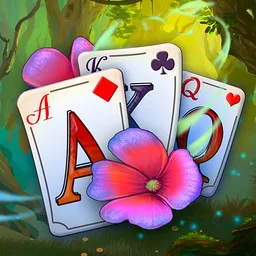












Tri Peaks Emerland Solitaire builds its puzzle on tri-peaks solitaire, a tableau shape credited to Robert Hogue, who introduced it in 1989 as a faster, more visual alternative to Klondike. This particular version comes from Rainbow Games, developed by Andrey Mesheryakov, whose Emerland Solitaire series wraps the same card logic in a recurring fantasy setting; the same studio publishes a companion mobile app, Emerland: TriPeaks Solitaire, on Google Play.
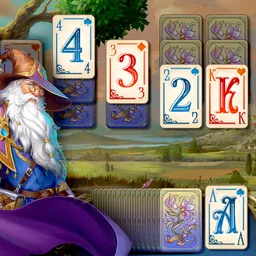
The board lays three overlapping peaks of face-up and face-down cards above a single waste pile. You clear a card by tapping any face-up card ranked exactly one higher or one lower than the top card of the waste pile, and clearing a card reveals whatever sits beneath it on the peaks. The level ends when every card on the peaks is gone, or when you run out of moves and stock cards before that happens. Higher rows tend to bury more cards beneath them, so a rushed clear near the top of a peak can strand several useful ranks you will need later in the same level.
Progress is tied to a map of Emerland rather than a plain level list. Locations bring in different fantasy characters — dwarfs, elves, mermaids and others — some of whom carry a passive power that helps with a specific level's layout, and clearing peaks efficiently earns stars that unlock the next stretch of the journey. Wild cards appear on tougher boards and can match any rank, giving you an escape route when the visible chain runs dry. Some maps also introduce a limited number of shuffles or extra draws as a location-specific bonus, tying the story setting directly to a small mechanical twist rather than reusing identical rules on every map.
What separates it from a bare tri-peaks app is the sense of forward motion: instead of restarting the same board type over and over, each cleared level moves a marker across a hand-drawn world map, and the story dressing gives even a routine card-clearing session a reason to keep going. It is a lighter, more decorative take on the format than most straight solitaire ports. The presentation leans into full-color illustrated peaks and character portraits rather than a flat card-table background, which is part of why the series has spawned several spin-off titles under the same Emerland name.
It suits players who already like tri-peaks or Klondike-style patience games but want a bit of narrative wrapper around the puzzle, as well as anyone easing into card puzzles for the first time — the one-higher-or-one-lower rule is easy to explain in a sentence and hard to make truly unfair. It also rewards players willing to backtrack occasionally, since replaying an earlier, easier location for extra stars can unlock a shortcut past a later bottleneck on the map.
On LemonArcade it runs free in the browser, no download or account, on both desktop and mobile. Individual levels usually take a few minutes, difficulty climbs gradually as blockers and locked cards appear on later maps, and there is no payment requirement to keep progressing through the world. Later maps introduce enough locked and blocker cards that a level can take considerably longer than the early game suggests, so treat the opening hours as a tutorial for pacing rather than the full difficulty curve. On touch devices the tap targets are sized generously, which matters once several near-overlapping peak cards are visible during a crowded level.